First published in Norwegian in Aftenposten, 3 November 2026
(This is my original English version, before editing and translation.)
Whether America avoids an election crisis on Tuesday depends on Republicans who lose narrowly, not on Trump.
Last week, we saw two paths for a democracy. In Brazil, the defeated Flavio Bolsonaro is following in his father’s footsteps by declaring himself the rightful winner of a close presidential election he lost. In Serbia, the long-ruling former President Aleksandar Vučić accepted his electoral defeat despite 14 years in power. On Tuesday, November 3, it is American voters’ turn to vote. On the ballot will be how much power President Donald Trump will have for the rest of his term, because it decides who controls Congress. The question is: what will the electoral losers do?
By refusing to concede the 2020 presidential election, Trump has demonstrated his willingness to fight an election he lost. This time, he’s doing it before the election in the hope of maintaining his Republican majority in Congress. On October 22, in a seemingly unprecedented move, the Department of Justice sued the state of Alaska to preemptively block the certification of Senate results if the Republican candidate loses by a small margin. Trump proudly declared, “I’m the one that said do it.” The administration also sued California to remove 20,000 voters who were allegedly non-U.S. citizens.
Trump is not on the ballot, but his legislative control is
This election matters. At stake is congressional authority: the power of the purse, the confirmation of federal judges, and control of the committees that investigate the executive. All are checks on the Trump administration, which is precisely why it is already bending and breaking democratic rules to keep its Republican majority. But Trump is not on the ballot. It falls to the rank-and-file Republicans who are running to accept defeat or to fight it.
Democracy survives when everyone abides by the electoral “rules of the game”. This means that if you lose, you accept it and come back to play next time. It breaks down when players stop respecting those rules. My research and that of others on democratic norms shows that what matters most is often not the leader but whether rank-and-file party members hold the line. They are the ones who can “gatekeep” a leader from power. The leader needs them to pass his agenda, and when they break with him, it means far more to his supporters than opposition from the other party, who are expected to object anyway. That is what makes them one of the most effective barriers against politicians who want to break the rules. But it can come with a cost.
The cost of democratic rules
In 2020, the focus was on whether Trump would be allowed to break the rules to remain in office after losing the election. When Republicans adhered to democratic processes, such as Vice President Mike Pence certifying the 2020 election results despite Trump’s wishes, Pence paid dearly, with crowds calling for his hanging and it effectively ending his political career. Now, imagine dozens of congressional candidates facing that choice, where not only would they be going against Trump, but their personal political careers could also be on the line. Are they willing to prioritize the rules over their personal ambitions and Trump’s scorn?
What to watch on Tuesday
Limiting the focus to Senate races, the chart below highlights some of the most important races to watch, such as James Talarico (Democrat) vs. Ken Paxton (Republican) in Texas, Josh Turek (Democrat) vs. Ashley Hinson (Republican) in Iowa, and the particularly close race in Kansas between Adam Hamilton (Democrat) and Roger Marshall (Republican). There are other close Senate races, as well as many close House races.
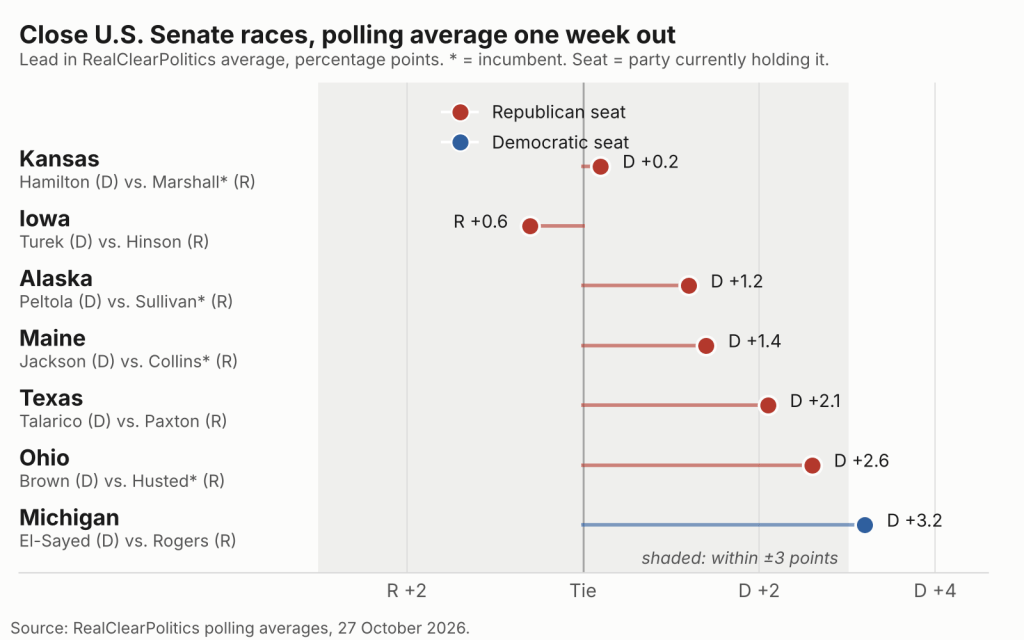
Those concerned with American democracy should hope for decisive outcomes, one way or the other. But in the closest races, a result may not be clear on the same night, and the question becomes whether Republicans who lose by a small margin will contest it. Trump will want them to. So, watch the narrow Republican losers, especially if the outcome decides control of Congress. The state of American democracy may then depend on the conscience of individual Republicans. If they concede, the rules of the game hold, regardless of what Trump says. If they do not, the United States would be following Brazil’s path, where losing a close election is becoming grounds to reject it.

